 Back to blog
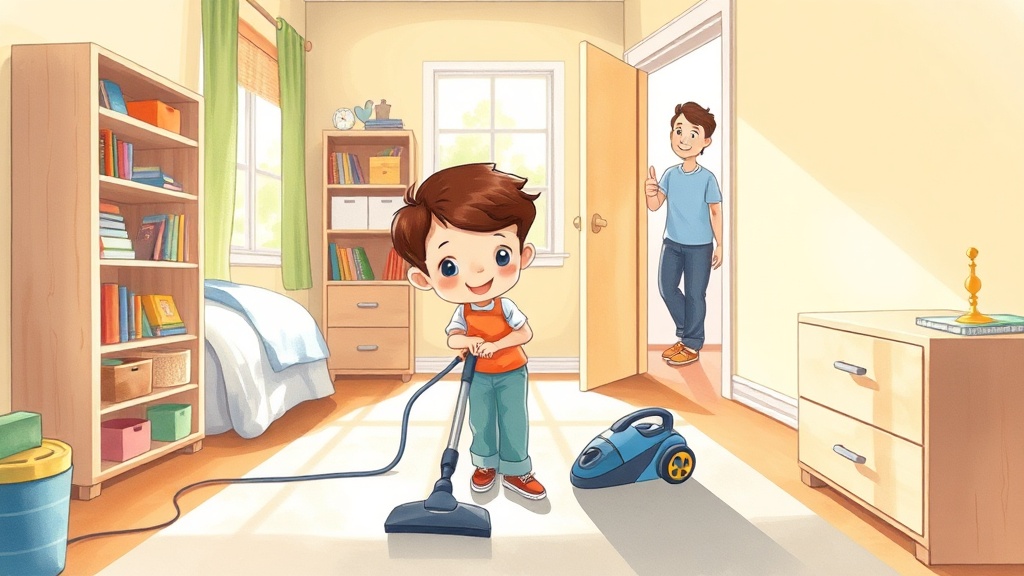
Chores for 7-Year-Olds: Building Capable, Confident Kids
At 7 years old, your child is entering a golden age for chores. They're past the toddler stage where "helping" often meant more work for you. They're not yet in the preteen resistance phase. And they're genuinely capable of meaningful contribution.
Seven-year-olds can follow multi-step directions, take pride in accomplishment, and manage real responsibilities. This is the time to build habits that last.
Here's your complete guide to chores for 7-year-olds.
What Makes 7 a Great Age for Chores
Developmentally, 7-year-olds are ready for more:
Physical Development:
- Strong fine motor skills (can fold, button, pour)
- Good gross motor coordination (sweep, vacuum, carry)
- Stamina for 10-15 minute tasks
- Can handle multi-step physical activities
Cognitive Development:
- Can follow 3-4 step instructions
- Understands time and sequence
- Beginning to plan ahead
- Can troubleshoot simple problems
- Reads and understands written checklists
Social-Emotional Development:
- Wants to be seen as "big kid"
- Takes pride in accomplishment
- Responds to responsibility (not babying)
- Can delay gratification somewhat
- Understands fairness and consequences
The combination makes 7-year-olds capable of contributing meaningfully to the household.
Complete Chore List for 7-Year-Olds
Self-Care (Fully Independent)
By age 7, these should happen without reminders:
| Chore | Notes |
|---|---|
| Get dressed completely | Including socks, shoes, weather-appropriate layers |
| Brush teeth (AM and PM) | Proper technique, though spot-check occasionally |
| Comb/brush hair | Simple styles; help with tangles if needed |
| Put dirty clothes in hamper | Every day, automatically |
| Put away clean clothes | In correct drawers |
| Pack own backpack | Check for needed items |
| Manage belongings | Coat, shoes, lunchbox in proper spots |
Bedroom Chores
| Chore | Frequency | Time |
|---|---|---|
| Make bed (properly) | Daily | 3-5 min |
| Keep room tidy | Daily | 5-10 min |
| Put toys away in right places | Daily | 5 min |
| Dust surfaces | Weekly | 5-10 min |
| Vacuum room (with teaching) | Weekly | 10 min |
| Change pillowcase | Weekly (with help on sheets) | 5 min |
| Organize toys and books | Monthly | 15-20 min |
Kitchen Chores
| Chore | Notes | Time |
|---|---|---|
| Set table completely | Plates, utensils, napkins, cups | 5 min |
| Clear own dishes | After every meal | 2 min |
| Load dishwasher | With guidance on placement | 10 min |
| Unload dishwasher | Lower racks, safe items | 10 min |
| Wipe table and counters | After meals | 3-5 min |
| Help with meal prep | Washing veggies, mixing, simple assembly | 10-15 min |
| Make simple breakfast | Cereal, toast, fruit | 5-10 min |
| Put away groceries | Non-breakable, reachable items | 10 min |
| Take out kitchen trash | When full, with reminders | 3 min |
Living Area Chores
| Chore | Frequency | Time |
|---|---|---|
| Pick up toys in common areas | Daily | 5-10 min |
| Dust furniture | Weekly | 10 min |
| Vacuum one room | Weekly | 10-15 min |
| Sweep floor section | As needed | 5-10 min |
| Sort laundry by color | Laundry day | 5 min |
| Fold towels and washcloths | Laundry day | 10 min |
| Match socks | Laundry day | 5 min |
| Water indoor plants | Weekly | 5 min |
| Bring in mail | Daily | 2 min |
Bathroom Chores
| Chore | Frequency | Time |
|---|---|---|
| Hang up towel after use | Daily | 1 min |
| Wipe sink after brushing teeth | Daily | 1 min |
| Put away bath toys | After bath | 2 min |
| Wipe bathroom counter | Weekly | 3 min |
| Empty small trash can | Weekly | 2 min |
| Help clean toilet (exterior) | Weekly, with supervision | 5 min |
Pet Care (With Supervision)
| Chore | Notes |
|---|---|
| Feed pets | Measure correct portions |
| Fill water bowl | Refresh daily |
| Brush gentle pets | With supervision |
| Help clean pet areas | Cages, beds, bowls |
| Walk dogs (with adult) | In safe areas |
Outdoor Chores (Seasonal)
| Chore | Season | Time |
|---|---|---|
| Water garden/plants | Spring-Summer | 10 min |
| Pick up sticks/debris | As needed | 10 min |
| Help rake leaves | Fall | 15 min |
| Shovel light snow (walkway) | Winter | 10 min |
| Help wash car | Warm weather | 15 min |
| Sweep porch/deck | As needed | 5-10 min |
How Many Chores for a 7-Year-Old?
Daily chores: 4-6 tasks (15-25 minutes total) Weekly chores: 2-3 bigger tasks (20-30 minutes total)
Sample Daily Schedule
Morning:
- Make bed ✓
- Get dressed ✓
- Brush teeth ✓
- Pack backpack ✓
After School:
- Empty lunchbox ✓
- Homework ✓
- Tidy room ✓
Evening:
- Set or clear table ✓
- Help with dinner task ✓
- Clothes in hamper ✓
Sample Weekly Schedule
| Day | Weekly Chore | Time |
|---|---|---|
| Monday | Vacuum bedroom | 10 min |
| Wednesday | Dust living room | 10 min |
| Friday | Help with laundry | 15 min |
| Saturday | Outdoor chore or project | 20 min |
Teaching New Chores to a 7-Year-Old
Seven-year-olds can learn more complex tasks with proper teaching:
The Four-Step Method
Step 1: Demonstrate Do the task while they watch. Narrate what you're doing: "First I push the vacuum in straight lines. I go all the way to the wall. Then I come back. See how I overlap a little so I don't miss spots?"
Step 2: Do Together Work side by side. Let them do the main task while you guide: "You vacuum this half, I'll do that half. Remember the straight lines!"
Step 3: Observe Let them do it while you watch. Offer tips without taking over: "You're doing great! Don't forget the corner by the door."
Step 4: Independent They do it alone. You spot-check afterward: "Looks good! I noticed one spot by the couch—want to grab that?"
How Long to Learn Each Task
| Chore Type | Learning Time |
|---|---|
| Simple (making bed) | 1-2 weeks |
| Moderate (loading dishwasher) | 2-3 weeks |
| Complex (vacuuming properly) | 3-4 weeks |
Motivating 7-Year-Olds
What works at this age:
Appeal to Their Pride
Seven-year-olds want to feel capable:
- "You're old enough to handle this now"
- "This is a grown-up job"
- "I trust you with this"
Visual Progress
They love seeing accomplishment:
- Sticker charts
- Check-off lists
- Before/after photos
- Choremon's virtual pet growth
Working Together
They still enjoy connection:
- "Let's do this together"
- Family cleaning time
- Sibling teamwork
Specific Praise
Be concrete about what they did well:
- "I noticed you got all the crumbs off the table—great job!"
- Not just "Good job!"
Avoid These:
- Treating them like babies
- Doing it for them because it's faster
- Constant correction during tasks
- Comparing to siblings
Common 7-Year-Old Chore Challenges
"They rush through and do it badly"
What's happening: Speed over quality, testing limits, or unclear expectations.
Solutions:
- Show them what "done" looks like
- "This isn't finished yet. What's missing?"
- Have them redo sloppy work (calmly)
- Quality check becomes routine
"They 'forget' every single day"
What's happening: Not yet a habit, or they've learned you'll remind.
Solutions:
- Visual checklist posted at eye level
- Tied to routine triggers ("after breakfast = make bed")
- One reminder maximum, then consequence
- Choremon's check-in system
"They complain constantly"
What's happening: Testing limits, genuinely tired, or need for connection.
Solutions:
- Acknowledge: "I know it's not fun. It still needs to be done."
- Don't engage with whining
- When/then: "When dishes are cleared, then you can play"
- Check if workload is appropriate
"They want payment for everything"
What's happening: They've connected chores to money (and want more).
Solutions:
- Clarify base chores vs. extra jobs
- "These are expected because you're part of our family"
- Extra jobs earn extra, base chores don't
- Use non-monetary motivation (like Choremon)
"Sibling conflict over chores"
What's happening: Fairness concerns, competition, or attention-seeking.
Solutions:
- Rotate chores so everyone does everything
- Age-appropriate expectations (older = more)
- Individual chore charts, not comparison
- Family meeting to address concerns
Chores and School Balance
Seven is first or second grade—school is getting more demanding.
School Day Priorities:
- Morning routine chores (non-negotiable)
- Homework
- Evening chores
- Free time
Adjusting for Busy Days:
- Lighter load on heavy homework nights
- Core chores always happen
- Catch up on weekends if needed
Signs of Overload:
- Constant homework battles
- No time for play
- High stress/meltdowns
- Resistance to everything
If you see these, simplify chores temporarily.
Allowance for 7-Year-Olds?
This is a family decision, but here are guidelines for age 7:
If You Pay for Chores:
- $3.50-$7 per week (50¢-$1 per year of age)
- Base chores vs. extra jobs distinction
- Pay on schedule, consistently
If Allowance Is Separate:
- Small amount for money practice ($3-5/week)
- Chores expected regardless
- Other consequences for incomplete work
If No Allowance:
- That's fine too
- Build in other goal-setting (saving for wants)
- Focus on contribution, not transaction
What's Next?
By age 8-9, your child will be ready for:
- More kitchen independence (simple cooking)
- Full laundry responsibility
- Helping with siblings
- Larger outdoor chores
- More complex organizing
The habits you build now are the foundation.
Track Chores with Choremon
Choremon makes chores engaging for 7-year-olds. They care for virtual pets that respond to completed tasks—Mons get happy and evolve when chores are done.
Why 7-year-olds love it:
- Visual progress they can see
- Mons they genuinely care about
- Simple enough to use independently
- No reading required for basic use
- Streak tracking (don't break the chain!)
Frequently Asked Questions
What chores should a 7-year-old do daily?
A 7-year-old should handle: making their bed, getting dressed independently, brushing teeth, packing their own backpack, putting dishes away, keeping their room tidy, and one household task (setting table, bringing in mail, etc.). This totals 4-6 daily tasks.
How long should a 7-year-old spend on chores?
Daily chores should take 15-25 minutes total. Weekly chores might add 20-30 minutes once a week. If chores are taking much longer, tasks may be too complex or there may be distraction issues.
Should a 7-year-old get paid for chores?
This is a family decision. Some pay allowance tied to chores ($3.50-$7/week for age 7), others give allowance separately, and some don't give allowance at all. What matters most is consistency in whatever approach you choose.
Can a 7-year-old vacuum?
Yes! Seven-year-olds can learn to vacuum with proper teaching. Start with a lightweight vacuum in one room. Teach straight lines, corner attention, and cord management. Expect the learning curve to take 3-4 weeks.
How do I get my 7-year-old to do chores without a fight?
Use when/then language ("When your chores are done, then you can play"), offer limited choices, set up visual checklists, establish consistent routines, and use engaging tools like Choremon. Avoid nagging—state expectation once and follow through with consequences.
Need chore guides for other ages? Check out our complete Age-by-Age Chore Guide covering ages 3-16.